
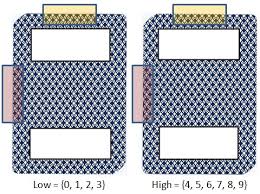
Baccarat edge sorting is an elite form of optical advantage play where a highly observant player identifies subtle, unintentional manufacturing asymmetries on the back patterns of playing cards to determine whether a face-down card is “big” (6, 7, 8, 9) or “small” (0 through 5) before a wager is placed.
By exploiting slight cutting irregularities—such as a diamond pattern being cut fully on one edge but only halfway on the opposite edge—players historically used superstition-based requests to trick dealers into rotating specific high-value cards 180 degrees. Once a significant portion of the deck is sorted and passed through an automatic shuffler that does not change card orientation, an advanced player can read the backs of the first four face-down cards, shifting the baseline baccarat math from a 1.06% house edge to an astonishing player advantage of over 20.90%. However, because modern brick-and-mortar properties have overhauled their security procedures and digital platforms use mathematically flawless, heavily audited Random Number Generator (RNG) engines, executing this technique in the modern era is virtually impossible. For real-money table game players across Australia who want to test systematic betting models under completely fair, unmanipulated conditions, running your wagers through a heavily secured and regulated digital platform ensures certified data encryption, audited software logic, and immediate local financial settlements.
The Technical Engine: Asymmetry and Card Sorting Math
To understand edge sorting, you must understand the card printing process. High-quality playing cards are printed in massive sheets and then cut mechanically. If the cutting blade drifts by a fraction of a millimeter, the pattern on the back long edges becomes asymmetrical.
+---------------------------------------------------------------------------------+
|                         VISUAL ASYMMETRY PATTERN MATRIX                         |
+---------------------------------------------------------------------------------+
|                                                                                 |
|   [NORMAL PATTERN LOGIC]  ===> Full Diamond Shapes on Left and Right Borders    |
|                                (Symmetrical: Identical when rotated 180°)        |
|                                                                                 |
|   [DEFECTIVE CUT PATTERN] ===> Full Diamond on Left / Half Diamond on Right      |
|                                (Asymmetrical: Visually changes when rotated)     |
|                                                                                 |
|                     ===================================                         |
|                     >>> HIGH CARDS FACING WAY "A"     <<<                       |
|                     >>> LOW CARDS FACING WAY "B"      <<<                       |
|                     ===================================                         |
|                                                                                 |
+---------------------------------------------------------------------------------+
When an advantage player successfully groups a deck, they look at the first card to be dealt from the shoe. Review the mathematical shift in player equity based on knowing just the top card’s value profile before placing a bet:
| Known Top Card Group | Optimal Betting Position | Baseline System Math | Theoretical Player Advantage |
| No Information (Standard Game) | Banker Position | Standard 8-Deck Matrix | -1.06% (House Edge) |
| No Information (Standard Game) | Player Position | Standard 8-Deck Matrix | -1.24% (House Edge) |
| High Card Group $\{6, 7, 8, 9\}$ | Player Position | Increases probability of natural 8 or 9 | +6.76% (Player Edge) |
| Low Card Group $\{0, 1, 2, 3, 4, 5\}$ | Banker Position | Favors the third-card drawing rules | +5.45% (Player Edge) |
| Four-Card Sorting Profile | Dynamic Strategy | Complete matrix knowledge | +20.92% to +33.23% (Player Edge) |
The Legal Landscape: Is Edge Sorting Cheating or Skill?
The question of whether edge sorting constitutes criminal cheating or acceptable skill has been thoroughly tested in major international and domestic courts. The legal consensus centers entirely on how the cards were manipulated.
1. International Precedents (Ivey v. Crockfords & Borgata)
In the famous multi-million-dollar lawsuits involving poker legend Phil Ivey and advantage player Kelly Sun, global courts ruled against the players. The UK Supreme Court and US District Courts determined that while the players did not physically mark or alter the cards, using social engineering to trick the dealer into rotating the cards for sorting crossed the legal line into game manipulation, breaching the casino’s terms of fair play.
2. The Australian Precedent (The Star Gold Coast Ruling)
In contrast, Australia’s legal system has delivered fascinating, highly distinct rulings regarding edge sorting. In a milestone case reviewed by the Queensland Civil and Administrative Court involving two local players banned from The Star Gold Coast casino, the judge officially revoked the casino’s ban.
The court ruled that the players did not engage in any form of dishonesty or cheating. Because the players simply used their natural eyesight to spot printing defects and took advantage of “sloppy dealers” without using any hidden devices or physical markers, the court acknowledged it as legitimate advantage play under local ordinary standards, placing the onus back on the casino to provide flawless equipment.
Why Edge Sorting is Obsolete in the Digital Era
While the legal history of edge sorting is fascinating, the structural evolution of modern gaming has completely eliminated the technique’s practical viability:
- Flawless Digital RNG Engines: In online table game environments, cards are not physical objects. They are rendered instantly on-screen based on mathematical outcomes generated by a secure, highly audited Pseudo-Random Number Generator (PRNG). Because there are no physical edges, pattern asymmetry cannot exist.
- Eight-Deck Digital Card Shuffling: Virtual platforms utilize electronic shuffling mechanisms that completely randomize the entire 416-card pool between every single deal, preventing any long-term sorting or card tracking.
- Live-Dealer Card Security: Modern live-dealer streaming studios deploy strict card-handling protocols. Decks are swapped out frequently, automated continuous shuffling machines (CSMs) rotate the physical orientation of cards randomly during every cycle, and card backs feature completely borderless, solid-color symmetry to block any optical exploitation.
Systematic Table Risk Management Framework
Because advanced physical card-reading techniques cannot be used to beat online baccarat, smart players rely on disciplined capital allocation to manage risk and protect their session bankrolls. Follow this 4-step workflow:
Pre-Session Table Calibration Workflow
Verifying a Secure Digital Table Infrastructure
To ensure your table strategies run under completely fair, transparent, and secure conditions, always verify that your chosen online casino meets these essential operational standards:
- Direct RGS Server Authentication: Ensure all virtual and live-dealer baccarat tables connect directly to heavily audited software providers via secure API tokens. This guarantees unmanipulated card distributions and true mathematical randomness.
- Optimized Local Financial Settlements: Look for platforms that support secure, direct local banking methods, popular digital wallets, and advanced cryptocurrency options to ensure fast, friction-free deposits and withdrawals.
- Native Player Protection Dashboards: A reputable casino must empower you with immediate, user-facing profile controls to set daily deposit caps, firm session loss boundaries, and temporary cool-off intervals instantly.
- Advanced Encryption Safeguards: Every network connection and financial link must be shielded by high-grade SSL/TLS encryption architectures, keeping your personal identity points and transaction history completely safe from external data vulnerabilities.
- Turnover Loyalty Rebates: Choose an ecosystem that automatically tracks your active table play volume to deliver systematic loyalty rebates, placing real value back into your wallet balance over long-term play.
The Professional Reality Check: No strategic calculation, historical tracking, or progressive staking system can permanently eliminate a table game’s built-in mathematical house edge. Because independent, certified random number generators or real, physical card shoes calculate every single deal as a completely isolated independent event, baccarat tables can experience extended shoe streaks or unexpected ties entirely at random. Never let temporary emotions guide your staking sizes. Treat table games as a premium source of digital entertainment, manage your funds wisely, and always play within your financial limits.
While the history of baccarat edge sorting highlights the incredible ingenuity of professional advantage players and the complex legal evolution of casino gaming, modern players must rely on real data and smart bankroll discipline. By understanding that online tables operate on flawless mathematical randomness, you can bypass overhyped betting myths and focus on structured, low-risk session management.
Always pair your table play with a trusted, transparent, and legally compliant online casino that prioritizes advanced data security and complete player protection. Set your boundaries early, select your table profiles carefully, and always play responsibly!